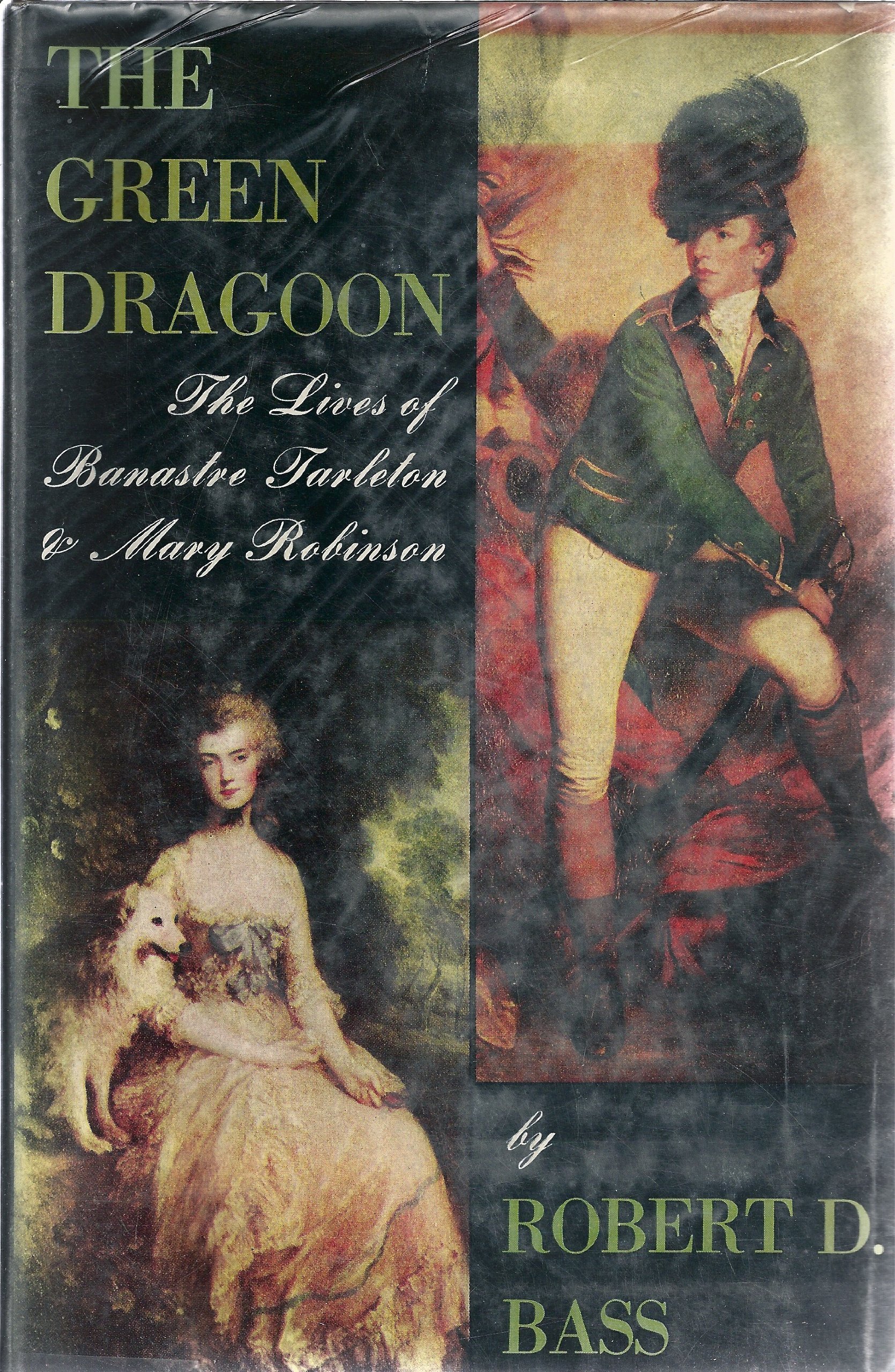
The Green Dragoon,
The lives of Banastre Tarleton and Mary Robinson
– Written by Robert D. Bass
Reviewed by Chris Parker
This is a big book and if I may confess I am really only interested in his exploits during the American Revolution. That being said I did attempt to read the rest of the book and got about half way through that and then skimmed the rest. For the reader please be aware this is really two books on his life. The majority of the book deals with his life after his return to England after being badly hurt during the York Town campaign and his on and off relationship with Mary Robinson.
As I wrote above I was interested in his military career and decided to read the book based on how well I liked the author’s book on Francis Marion called The Swamp Fox.
The author covers Tarletons life leading up to joining the military briefly but in a way that reinforces for me his way of acting in his military. He was born to a reasonably well off family in Liverpool and sent to a good school. There he fell off in favor of the usual vices that take many away from their education. Gambling, drink and woman led him to partial ruin and his family was able to secure him a very minor commission in the military. When the war broke out he requested temporary leave from his unit to serve as a volunteer in the British Army leaving for America. This was granted and off he went. He was appointed to the cavalry and he immediately showed that his dash and outrageous confidence was of use to the mounted arm in this theatre. He spent some time fighting in the New York – New Jersey theatre and was paired with Major John Simcoe’s forces.
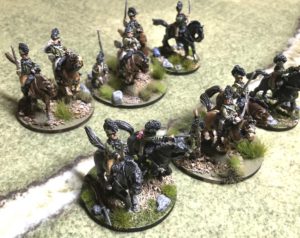
Tarleton was assigned to the force that headed to the southern states and again excelled in his command with his unit called the Green Dragoons. This unit was a specialized unit called a legion. Legions were raised by both sides and they performed much like today’s fighting forces in that they are made up of mixed arms. Tarleton’s for example was made up of both cavalry and infantry. Many times they had other troop types attached to them such are artillery, regular infantry or even mounted jaegers. Often the infantry would ride behind the cavalry on the same horse which of course turned the whole force in a mounted strike force.
Legions like The Green Dragoons were excellent for fighting in close terrain and their speed made them excellent for both patrolling wide areas of territory or making swift strikes. The Green Dragoons were often deployed in a large area where their sole mission was to keep the rebel militia from forming up. They often struck such groups as they were forming up or marching to a destination.
Tarleton’s reputation grew perhaps out of proportion to his feats until he met a small American Army at the battle of The Cowpens. Here he met his match in the American General Daniel Morgan. Morgan had a large force of militia in his army and he knew from past experience that would not hold against an elite force such as Tarleton’s. He was wise and asked his commanders for their input as to what sort of general Tarleton was. The general reply was that he acted fast and was often headstrong and just charged. He also was quick to assume that movement to the rear by an enemy meant they were done. Morgan put this knowledge to good use and defeated Tarleton handily at the Cowpens. For many this battle was the turning point of the war and it encouraged other countries as well as many Americans who were on the fence to become involved in the struggle.
The book moves on with the fighting in the south and then follows the British under Cornwallis and Tarleton to York Town. I must confess I knew nothing about this part of the war and was fascinated by it. Tarleton was the eyes and ears of the British Army and he performed very well. Eventually he joined up again with Simcoe’s Legion who were operating in the area and combined they were a mighty force to recon with. This part reminds of the Gettysburg campaign in that General Lee was counting information from his cavalry officer General J.E.B. Stuart only in General Lees case his cavalry let him down and left him blind.
The military part of the book finally ends when Tarleton and Simcoe attempt across the York River to Gloucester Point and break out. Unfortunately bad weather hampered the crossing of the bulk of the army and what forces made it or were already there were cut up in a sharp action with among other units Lauzon’s legion. In this action Tarleton escaped death but was pinned under a horse and broke both legs. He was paroled and returned to England, for him the war was over.
I will end my review at this point, I recommend this book highly to any reader who is interested in the American Revolution and the Southern campaign in particular. The rest of the book would be of great interest to anybody interested in the life and times following the war in England and Europe. It is a fascinating time and the writing is superb.
$40 on Amazon if you can’t find it locally
I highly recommend this book as well as Mr. Bass’s other book – Swamp Fox: The Life and Campaigns of General Francis Marion
Chris Parker
(note – I earn a small commission if you use any Amazon link, thank you)
Views: 305